Configured once. Decided every turn.
Transcript
- 0:01
A voice agent is only as smart as the decisions it can make without guessing. So where does that intelligence live? In VARTA, it lives in the workflow. DAKSH configures it once. VARTA decides with it, on every turn.
- 0:17
Here is a real-world example: a KYC refresh call for an international bank. Thirteen steps, two early exits, and branches wherever the caller's answer changes the path. Every step on this map carries its own configuration, written by DAKSH and approved by the team.
- 0:36
First, the voice. Every line the agent can say is recorded in advance: each question, each confirmation, each system line, in every language the workflow supports. Nothing waits on live speech synthesis.
- 0:53
Step two asks: am I speaking with Daniel Carter? DAKSH has written the words that mean yes and no. Yes, speaking, that's me. No, wrong number. The branch is picked by those words, in milliseconds. And if Daniel says, sorry, can you repeat that, a reflex replays the question. No model involved.
- 1:15
Then, consent. Callers are rightly cautious. Wait, is this a scam? Empathy mode recognises suspicion and answers with a calm, pre-recorded reassurance, then returns to the question.
- 1:31
Date of birth. People don't speak in database format. March fourteenth, nineteen eighty-nine, becomes a clean date, through number and date maps DAKSH prepared for the language. A format rule checks it, the agent reads it back, and yes, that's right, is accepted instantly.
- 1:50
Passport number. K, L, seven two nine, four zero one eight, becomes one clean passport number. A built-in format rule validates it, and the read-back speaks only the last four characters. And if Daniel says, I don't have it with me, a rule written in plain English defers the step politely, instead of asking a model what to do.
- 2:14
After the address, a question with logic behind it. How long have you lived there? If it's under three years, the bank needs the previous address too. That's a condition branch: a number, a comparison, a destination, decided by the engine.
- 2:32
Employment status. Nobody says self-employed the way a form does. I run my own consultancy means self-employed. I work for a software company means employed. DAKSH writes those aliases ahead of time, and each option routes to its own next step. Self-employed callers are asked for the business name. Everyone else moves on.
- 2:54
Some configuration watches the whole call. If Daniel asks to dispute a card charge, an out-of-scope rule routes him to card services. If he asks for a real person, handoff words connect him straight away. Abuse gets a warning, then a polite close. And an observer watches across turns: if the line keeps breaking up, it asks him to repeat, then offers a person instead of looping.
- 3:20
Put together, the call runs inside the engine. Identity, consent, date of birth, passport, address, employment: decided by configuration, spoken from audio prepared in advance. The language model is kept for what nobody wrote down. That's call containment.
- 3:39
And the basics are all there too: the agent's persona and name, the language and a second language, the language style and tone, from formal English to casual, the voice, and its speaking pace. Set once, per workflow.
- 3:56
DAKSH configures it once. VARTA decides every turn. Fast, predictable, and built for business.
About this film
An illustrative KYC refresh call for an international bank, thirteen steps with their branches. At each step the film opens the configuration DAKSH writes, using the real VARTA fields: branch keywords, spoken dates and letters turned into clean values, built-in format rules and read-back confirmation, a plain-English rule that defers a step, a condition branch on a number, slot aliases with option routing, empathy mode for a caller who suspects a scam, and guard rails on every step: out-of-scope routing, handoff words, an abuse policy and a call observer. Every line is audio prepared in advance, and the language model is kept for what nobody wrote down.
4:07 · · English captions
More films
Teaser · 56 s
The model can wait.
In a world where every voice agent waits for a model, one engine decided not to wait. Rules first, model last: seven layers, zero hesitation, the same voice at half the bill.

Explainer · 4 min
Train once. Run a million calls.
DAKSH uses a language model once per workflow, the way a programmer uses a compiler. VARTA runs every call on seven layers of code, asks the model last, and never lets it invent a route.
Head to head · 1 min
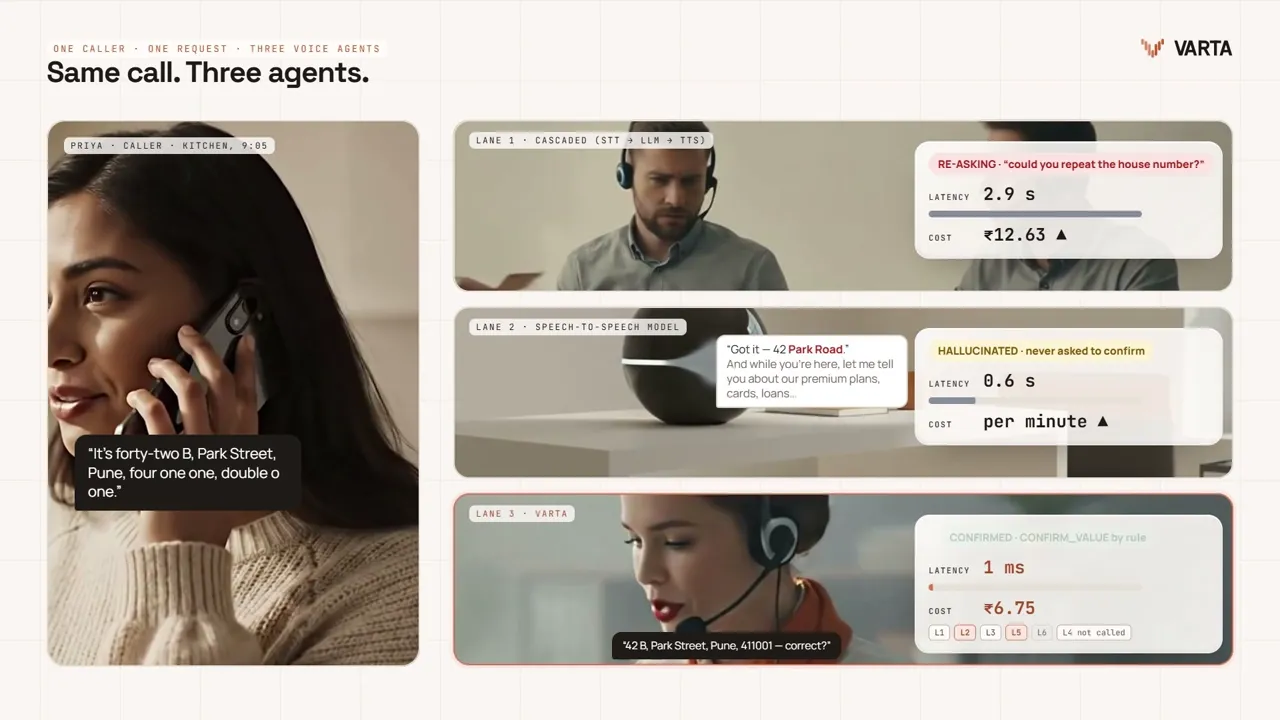
Same call. Three agents.
One caller, one request, three voice agents: a cascaded pipeline, a speech-to-speech model and VARTA. Watch which one waits, which one mishears the address, and which one confirms it by rule.
Inside the engine · 47 s
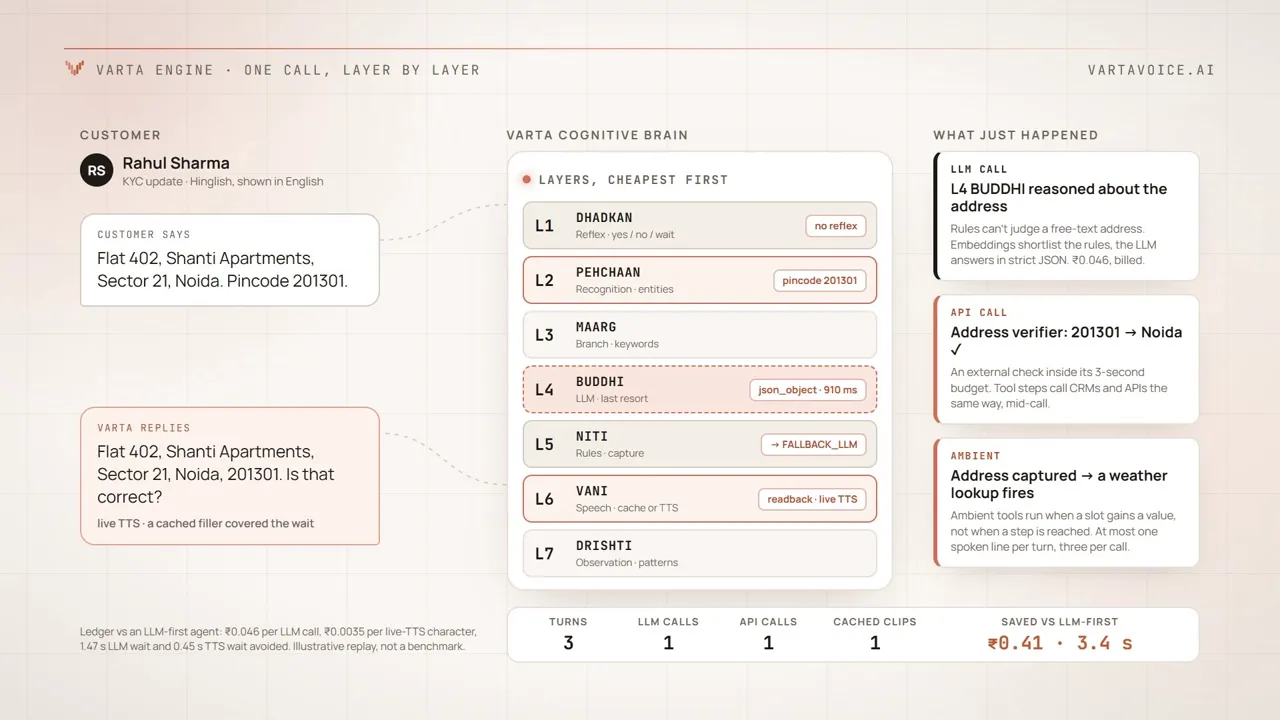
One sentence through the VARTA engine
Follow one caller sentence through VARTA layer by layer: reflex, recognition and rules first, an LLM only when nothing else can answer, every step on one visible ledger.
For enterprise · 1 min
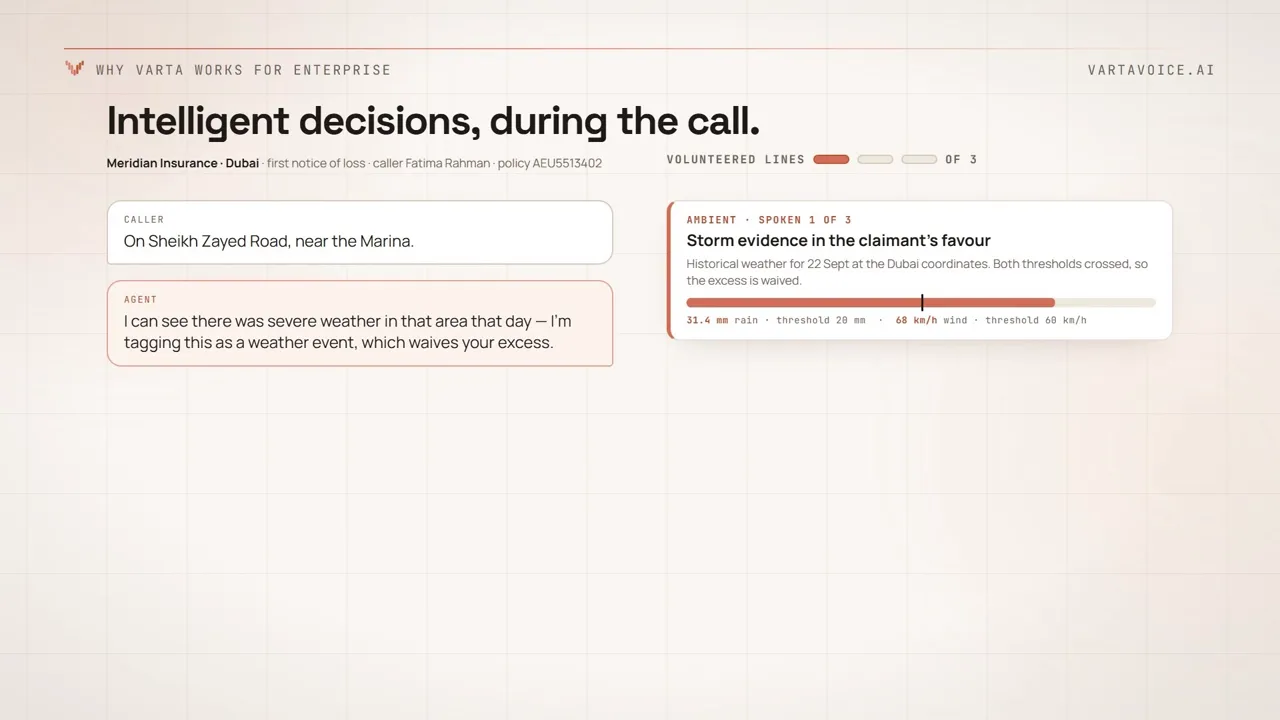
Why VARTA works for enterprise
Fluency no longer closes deals. Decisions by rule, writes to your ERP mid-call, live data volunteered only when a threshold is crossed, and a deterministic cost engine, in four markets.
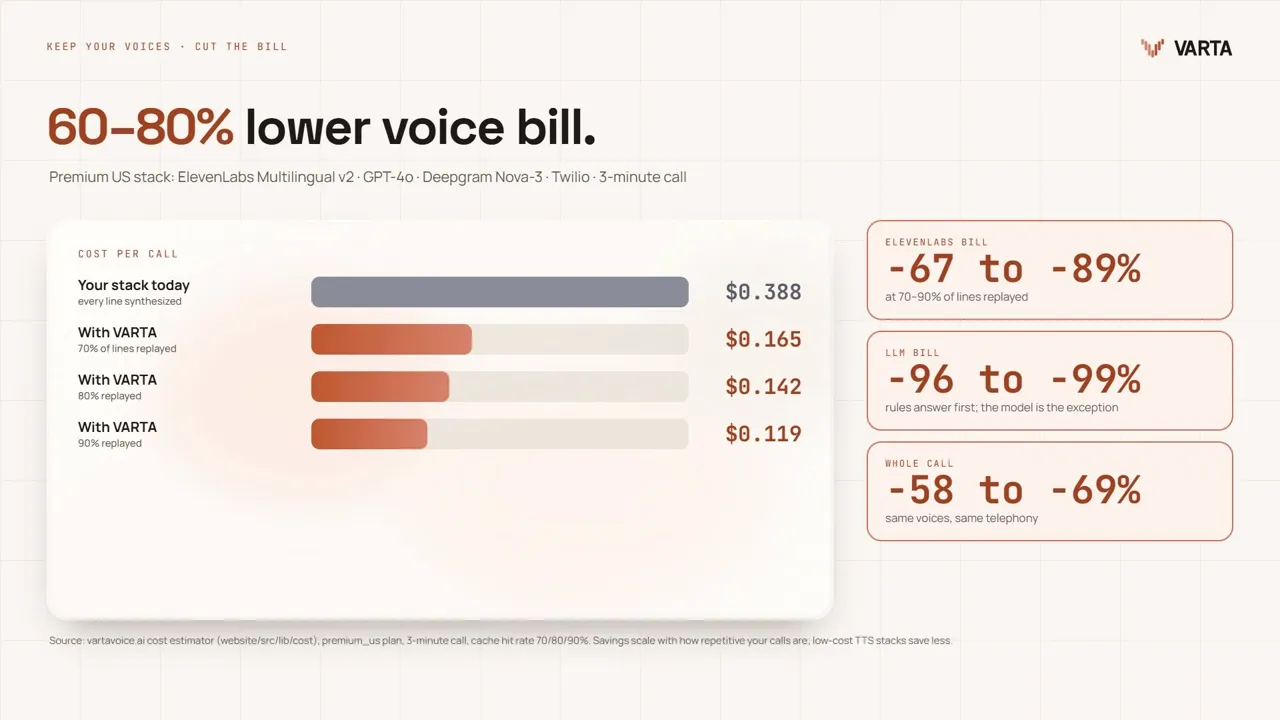
Premium voices · 1 min
Keep your voices. Cut the bill.
Keep the premium voice you chose. VARTA replays the lines an agent has said before from cache, in the same voice, and sends only the new ones to your provider.
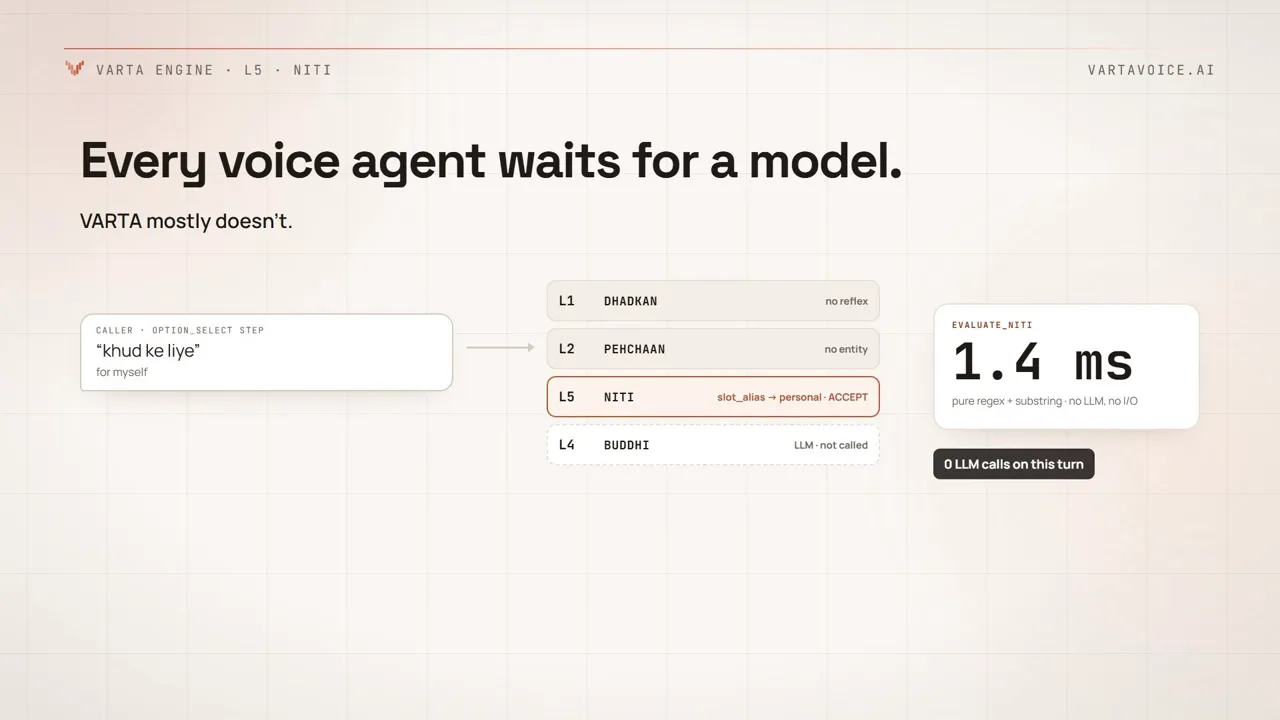
Layer 5 · 1 min
NITI: the rule engine inside VARTA
Every voice agent waits for a language model. VARTA mostly does not. NITI resolves a turn by rule in under two milliseconds, with the LLM as the last resort.
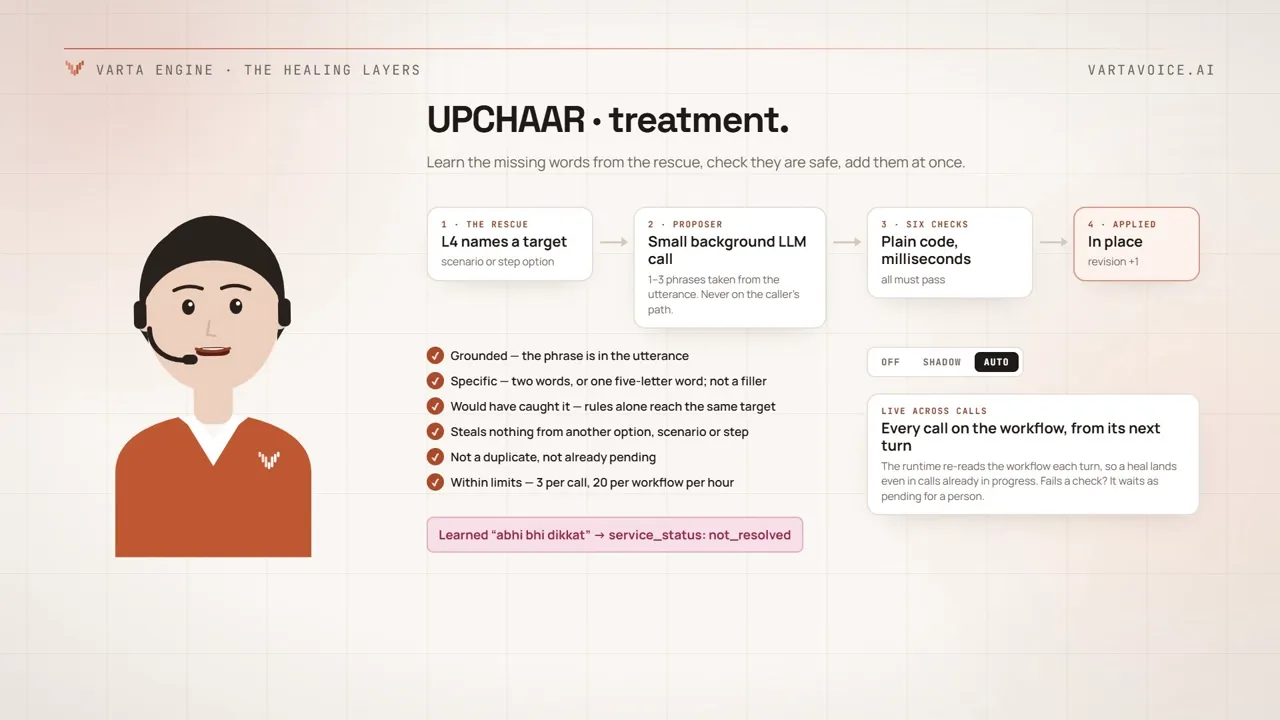
UPCHAAR and SHALYA · 2 min
How VARTA heals itself
Most voice agents stay as smart as the day they were written. VARTA’s two healing layers learn from every LLM rescue and propose structural fixes, checked before anything goes live.
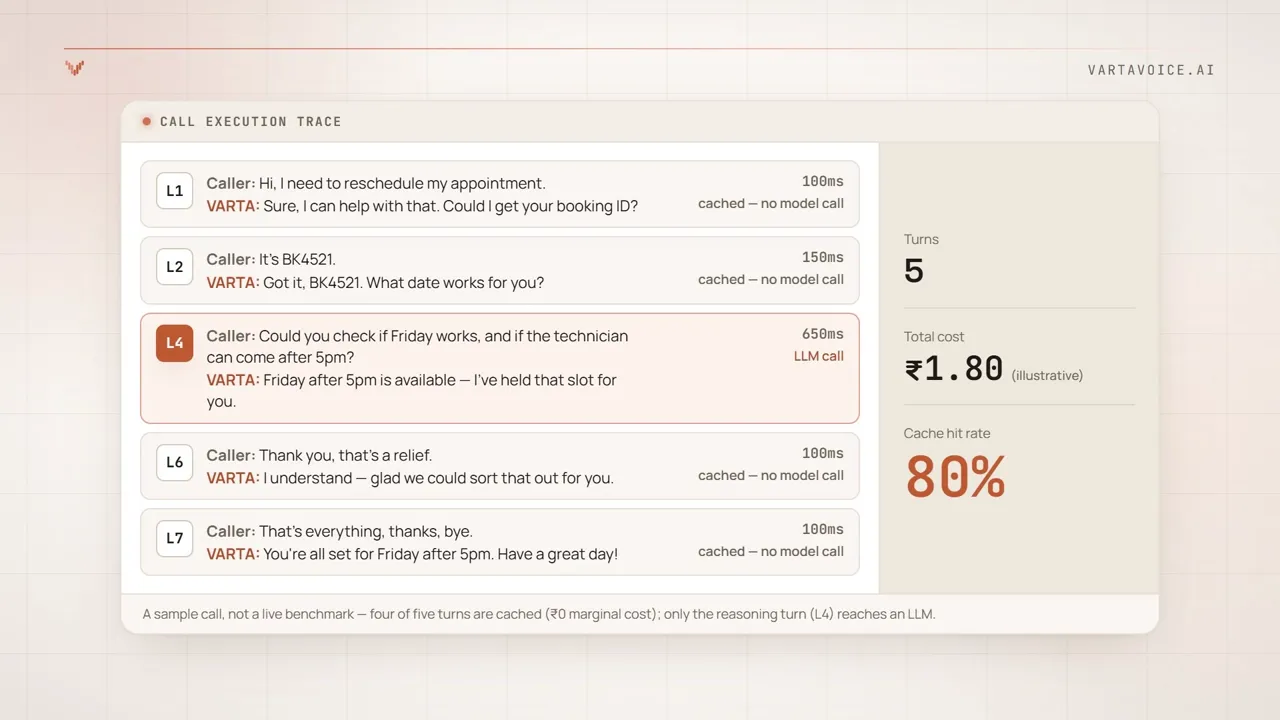
Launch film · 24 s
Introducing VARTA
A voice-agent platform with a visible cost ledger: seven explicit layers, cached audio for repeated phrasing, and only the turns that need reasoning reach an LLM.